Brew Fusion
Gicherori AA - Kenya {Washed} - POMA
Gicherori AA - Kenya {Washed} - POMA
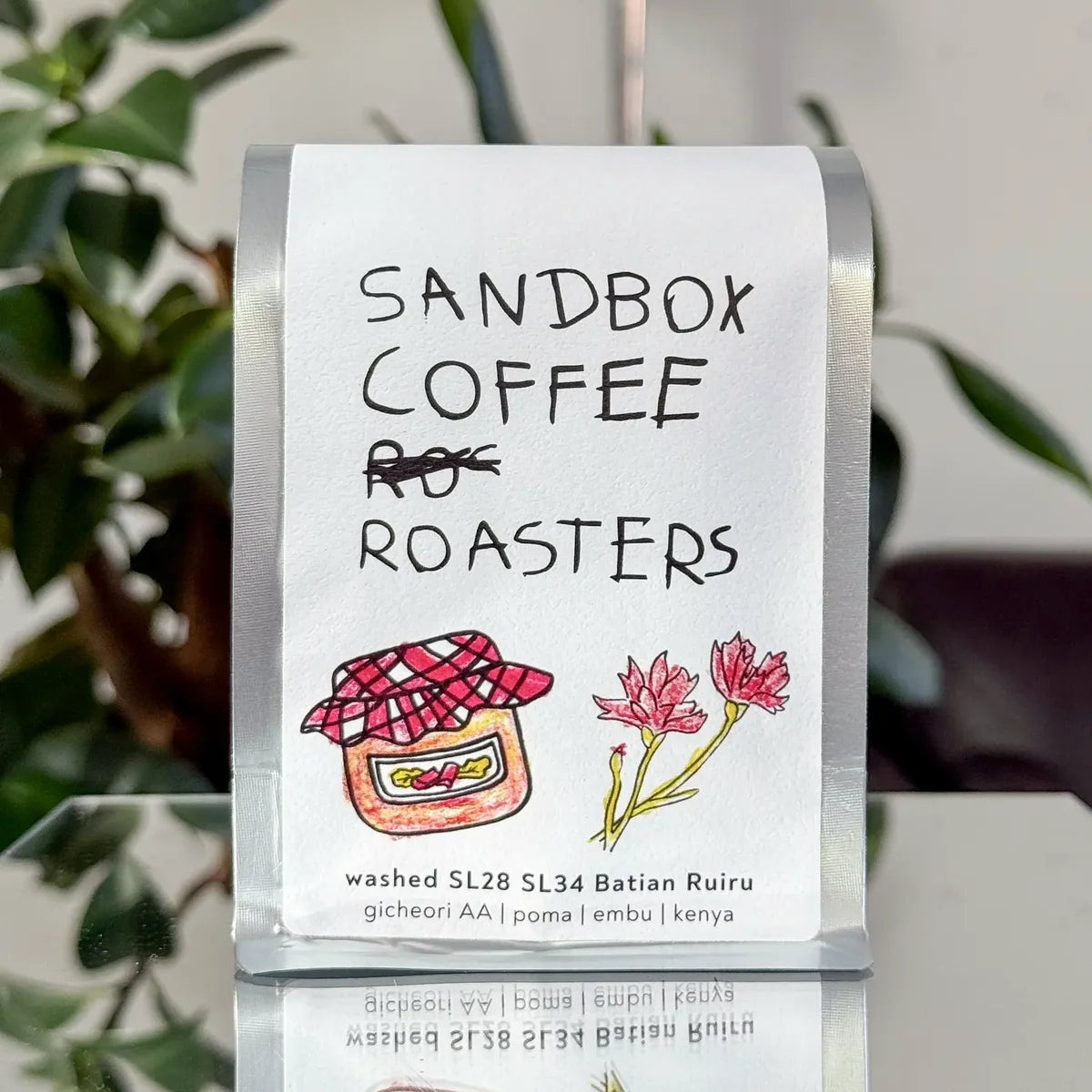
A Kenya AA from Sandbox Coffee Roasters in collaboration with POMA Coffee Research. Produced in Gicherori, Embu, this washed lot combines SL28, SL34, Batian, and Ruiru 11, with notes of jasmine, redcurrant, and raspberry. Very light roast, available in 200g.
Couldn't load pickup availability
ESPRESSO/FILTER - 2000g
ORIGIN: Embu, Kenya
PRODUCER: Gicherori Coffee Factory, Kibugu Farmers' Cooperative Society
COLLAB: POMA Coffee Research
VARIETY: SL28, SL34, Batian, Ruiru 11 (AA)
PROCESS: Washed
NOTES: Jasmine, Redcurrant, Raspberry
Roast Date: 24/10/2026 (light roast)
Traceability
Traceability
Technical Sheet
Roaster: Sandbox Coffee Roasters
Origin: Embu, Kenya
Station: Gicherori Coffee Factory
Cooperative: Kibugu Farmers' Cooperative Society
Producers: Smallholder farmers from the cooperative
Collaboration: POMA Coffee Research
Varieties: SL28, SL34, Batian, Ruiru 11
Process: Washed
Classification: AA - Screen 17/18
Harvest: 2026
Tasting Notes: Jasmine · Redcurrant · Raspberry
Sweetness: 3/5 (according to Sandbox)
Complexity: 3/5 (according to Sandbox)
Acidity: 3/5 (according to Sandbox)
Roast: Very Light Roast
Ideal for: Filter and Espresso
Format: 200g
Why we like it: A Kenya AA that combines the floral character of jasmine with the fruit intensity of redcurrant and raspberry. Its collaboration with POMA Coffee Research and its very light roast make it an interesting choice for discovering a clean and precise expression of Kenyan coffee.
Who should buy it: Ideal for lovers of washed Kenyan coffees, floral profiles, and red fruits. Especially recommended for those who enjoy very light roasts, defined acidity, and coffees with a transparent expression of their origin.
Description
Description
Gicherori AA is a specialty coffee from Embu, Kenya, produced at the Gicherori station and selected through POMA Coffee Research, a coffee research company based in Copenhagen.
This washed lot combines four iconic Kenyan varieties: SL28, SL34, Batian, and Ruiru 11.
Its profile is distinguished by a delicate floral expression, red fruits, and a bright, defined acidity.
Roasted by Sandbox Coffee Roasters with a very light profile, it presents notes of jasmine, redcurrant, and raspberry, accompanied by a juicy sweetness and a clean finish.
Gicherori Coffee Factory - Embu, Kenya
Gicherori Coffee Factory is located in Embu County, on the slopes of Mount Kenya.
It is part of the Kibugu Farmers' Cooperative Society, a cooperative that brings together approximately 1,200 smallholder farmers and operates five processing stations.
The Embu region is known for producing coffees with an intense fruit expression, vibrant acidity, and defined aromatic profiles.
This lot receives the AA classification, corresponding to one of the largest bean sizes in the Kenyan grading system.
The AA category refers to bean size, generally screen 17/18, and does not represent a cupping quality score in itself.
POMA Coffee Research
POMA Coffee Research is a research and roasting company based in Copenhagen, co-founded by Rasmus Madsen.
Its work focuses on understanding and improving coffee production through research, experimentation, and direct collaboration with farmers.
POMA develops trials both in greenhouses with controlled climate conditions and on partner farms, including a research plot in Embu, Kenya.
Its involvement in this lot connects the work of the Gicherori farmers with a scientific and innovative vision of specialty coffee.
The varieties: SL28, SL34, Batian, and Ruiru 11
This coffee combines four varieties that represent different stages of Kenya's coffee history.
SL28 and SL34 were originally selected by Scott Laboratories and are known for their cupping quality potential.
SL28 belongs to the Bourbon group and stands out for its drought resistance and its ability to produce complex profiles.
SL34 has genetic background similar to Typica and was selected from a tree at Loresho Estate, in Kabete.
On the other hand, Ruiru 11 and Batian are varieties developed to improve resistance to coffee plant diseases.
Ruiru 11 was introduced in 1985, while Batian is a composite variety with resistance to rust and coffee berry disease.
The combination of these four varieties brings together the traditional character of Kenyan coffees with varieties developed to provide greater agricultural resilience.
Washed Process
Processing begins with the selective harvesting of ripe cherries.
Subsequently, the cherries are pulped to remove their outer skin and the beans undergo a controlled fermentation intended to remove the remaining mucilage.
After washing, the coffee is transferred to drying beds, where the beans are regularly turned to promote a uniform loss of moisture.
In a conventional washed process, drying usually lasts between one and two weeks, depending on environmental conditions.
This method seeks to preserve aromatic clarity and highlight the natural characteristics of the varieties and their origin.
Sensory Profile
In the cup we find notes of jasmine, redcurrant, and raspberry.
Jasmine provides a delicate and elegant floral opening.
Redcurrant introduces a bright and crisp acidity, while raspberry adds a juicy red fruit sweetness.
The whole offers a clean, expressive, and balanced cup, with a defined finish and a pleasant freshness.
Sandbox Coffee Roasters describes this coffee with the following sensory intensities:
- Sweetness: 3/5
- Complexity: 3/5
- Acidity: 3/5
Its very light roast seeks to preserve the transparency of the origin and allow the characteristics of the varieties to express themselves clearly.
Following the philosophy of Sandbox, this coffee is not limited to a single brewing method: it can be explored in both filter and espresso.
Recipes
Recipes
Coming soon...
Compartir